
Introduction
Automotive supply chains are built around movement.
Thousands of components can move between suppliers, warehouses and OEM assembly facilities.
Every movement requires packaging.
When packaging is disposable, the supply chain continuously consumes new packaging.
When packaging is returnable, the same packaging assets can support repeated component movements.
This makes returnable packaging particularly relevant to automotive and OEM supply chains.
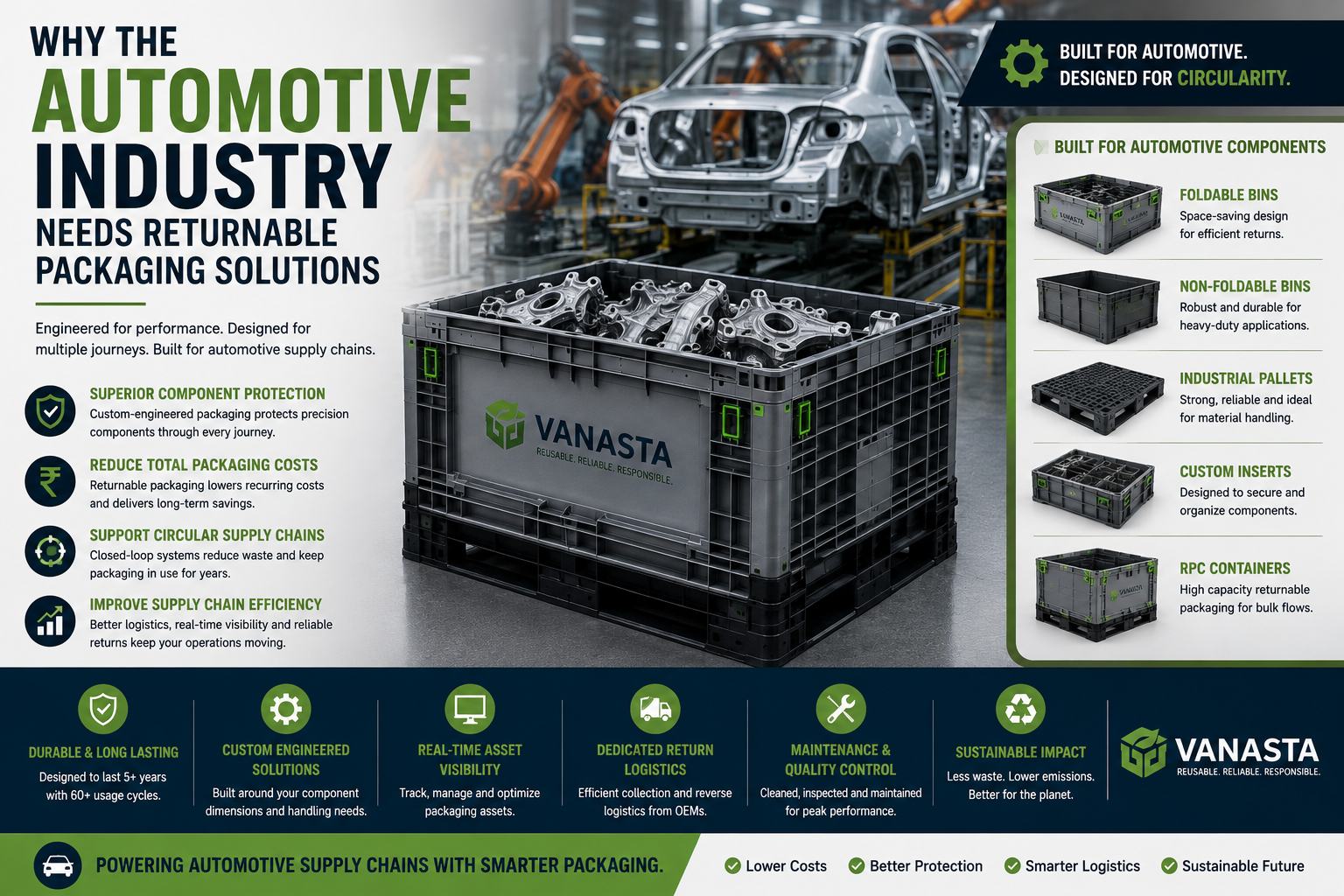
VANASTA identifies automotive and OEM operations as a core industry application, with packaging designed for component movement between suppliers and OEM assembly facilities.
Automotive Components Need Application-Specific Protection
Automotive components are not all the same.
They differ in:
- Size
- Shape
- Weight
- Fragility
- Surface requirements
- Handling method
- Assembly sequence
Using generic packaging for every component can create unnecessary handling challenges.
Custom packaging can instead be designed around the component.
VANASTA provides custom design engineering based on component dimensions, specifications and operational requirements.
Packaging and OEM Logistics
The relationship between supplier and OEM is highly dependent on predictable component movement.
Packaging needs to support this flow.
A typical returnable packaging cycle can involve:
Supplier → OEM → Empty Packaging Recovery → Warehouse → Supplier
This is fundamentally different from:
Supplier → OEM → Disposal
The first model creates an asset loop.
Returnable Bins for Automotive Components
Reusable plastic bins can be designed for repeated movement.
VANASTA’s portfolio includes foldable and non-foldable plastic bins, as well as PP bins and custom inserts.
Custom inserts can help position components correctly within the container and organize multiple components.
Industrial Pallets
Automotive components also require platforms for material handling and transportation.
VANASTA’s industrial plastic pallets are designed as heavy-duty platforms for safe material handling and transportation.
The right pallet system can become an important part of warehouse and transportation operations.
Why Reverse Logistics Matters for Automotive OEMs
The biggest operational challenge with returnable packaging is ensuring that packaging comes back.
A supplier cannot continue shipping components if all its containers are sitting at an OEM facility.
This makes collection planning essential.
VANASTA’s model includes dedicated collection and return logistics along with asset management capabilities.
Real-Time Asset Visibility
Another important requirement is visibility.
Businesses need to know:
- Where packaging is located
- How much packaging is available
- Which packaging is circulating
- Which assets need maintenance
- When additional packaging may be required
VANASTA includes real-time inventory management and proactive asset management among its services.
Benefits for Automotive Supply Chains
A properly implemented returnable packaging system can support:
Reduced recurring packaging purchases
Reusable packaging can reduce dependence on packaging designed for one-time use.
Improved component protection
Custom packaging can be developed around individual components.
Better logistics coordination
Forward and reverse logistics can be managed as part of one system.
Improved asset visibility
Packaging inventory can be monitored throughout its lifecycle.
Reduced packaging waste
Packaging remains in circulation rather than immediately entering the disposal stream.
Leave A Comment