
Introduction
Manufacturing companies are under increasing pressure to improve efficiency while using resources more responsibly.
Packaging is an important part of this conversation.
Every component that moves through a manufacturing supply chain requires some form of protection, storage and transportation.
If that packaging is designed for one journey, the business repeatedly consumes packaging resources.
A sustainable packaging strategy asks a different question:
Can packaging remain useful for multiple journeys?
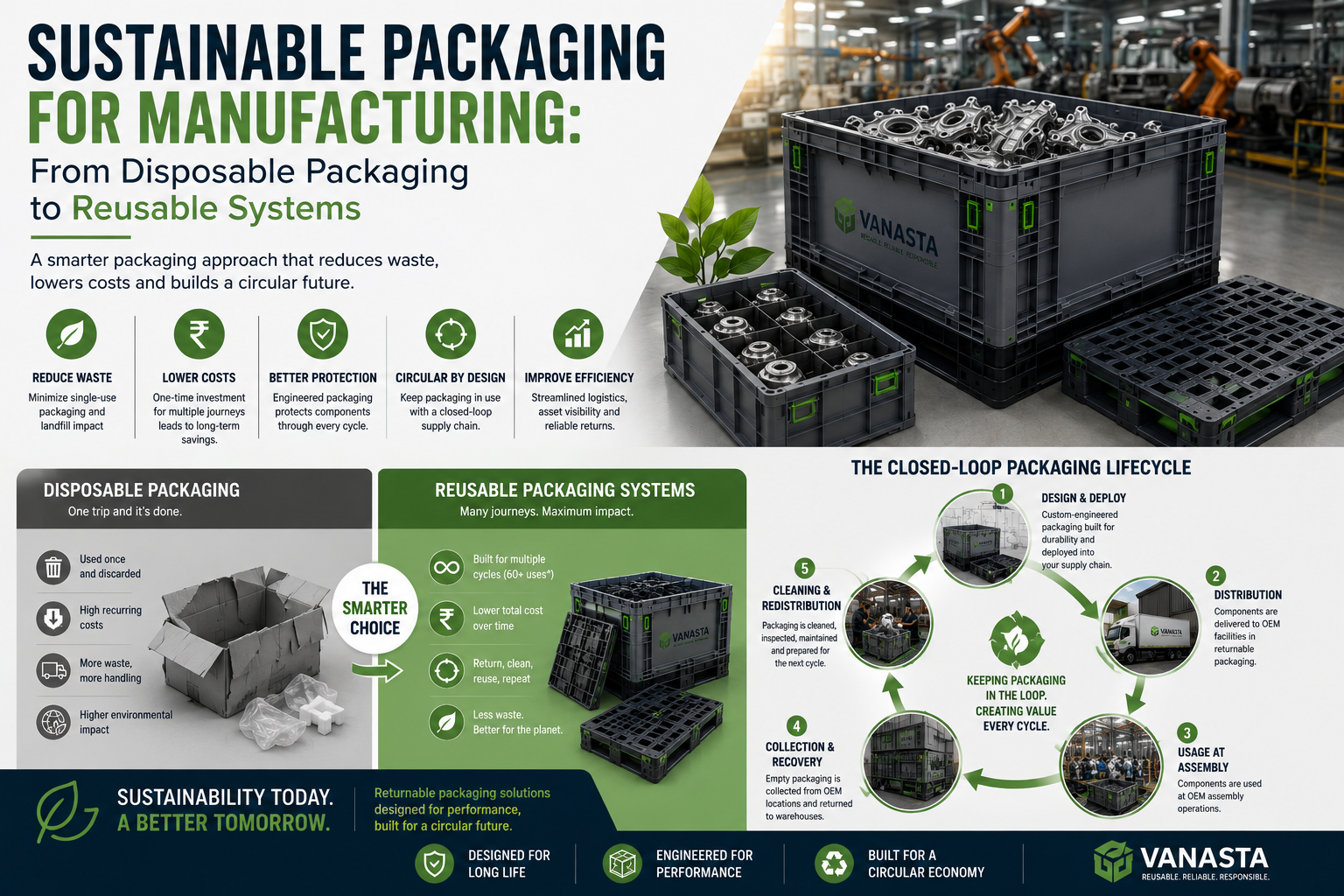
This is the philosophy behind VANASTA’s sustainable packaging approach.
What Is Sustainable Packaging?
Sustainable packaging is not simply about choosing a particular material.
It can also involve:
- Reuse
- Durability
- Longer service life
- Efficient transportation
- Recovery
- Recycling
- Resource optimization
- Circular supply chains
VANASTA’s material emphasizes keeping packaging in circulation, reducing dependence on disposable packaging and managing the complete packaging lifecycle.
Why Reuse Matters
Consider two packaging models.
Linear Model
Manufacture → Use → Dispose
Circular Model
Manufacture → Use → Recover → Maintain → Reuse
The second model extends the useful life of packaging.
Instead of creating a new packaging unit for every shipment, one durable packaging asset can support multiple movements.
Sustainable Packaging for Industrial Applications
Manufacturing supply chains often require packaging capable of handling repeated movement.
VANASTA serves applications across:
- Automotive and OEM
- Agriculture and tractor
- Manufacturing and industrial
- Industrial supply chains
These environments can benefit from packaging systems designed around actual product and logistics requirements.
Custom Engineering and Sustainability
Not every component should use the same packaging.
Poorly designed packaging can result in:
- Unused space
- Excess material
- Product movement inside containers
- Inefficient transportation
- Additional handling
Custom engineering allows packaging to be developed around the actual component and process.
VANASTA’s custom design engineering service focuses on component dimensions, specifications and operational requirements.
The Role of Reusable Plastic Packaging
VANASTA’s product portfolio includes:
- Foldable plastic bins
- Non-foldable plastic bins
- Industrial plastic pallets
- PP bins
- Custom inserts
- RPC containers
These products are positioned around durability, repeated use and supply-chain integration.
Sustainability Meets Business Efficiency
A sustainable packaging strategy should also make operational sense.
VANASTA explicitly positions returnable packaging as both an environmental and business decision.
The supplied material identifies potential benefits including:
- Reduced recurring packaging expenditure
- Minimized product damage
- Streamlined logistics
- Packaging asset utilization across multiple cycles
This is important because sustainability becomes more scalable when it is integrated into everyday business operations.
Reducing Single-Use Packaging Waste
One of the simplest principles behind reusable packaging is:
Don’t dispose of packaging after one journey if it can safely complete another.
VANASTA’s environmental framework identifies three key areas:
Less Single-Use Waste
Reduce packaging that would otherwise be discarded after a single journey.
Circular Material Flow
Use collection and reprocessing to keep materials within the value chain.
Longer Use
Design returnable packaging around multiple-use cycles and extended service life.
Why Reverse Logistics Is Part of Sustainability
A reusable package is only sustainable as part of a functioning return system.
If packaging is sent to an OEM and never comes back, the circular model breaks.
That’s why sustainable packaging needs to include:
- Collection
- Return transportation
- Cleaning
- Inspection
- Maintenance
- Redistribution
VANASTA integrates these activities into its closed-loop system.
Building a Better Packaging System
Manufacturers looking to move toward sustainable packaging should consider the complete lifecycle.
Key questions include:
- How often does the packaging move?
- How long can the packaging remain in service?
- Can it be collected efficiently?
- Can it be cleaned and maintained?
- Can it protect the component through repeated transportation?
- Can packaging inventory be monitored?
- Can packaging be redistributed efficiently?
- What happens to the material at end of life?
These questions move the conversation from packaging products to packaging systems.
Leave A Comment