
What Is a Circular Supply Chain?
A circular supply chain is designed around keeping resources and assets in productive use rather than treating them as one-way inputs.
In conventional supply chains, products and packaging often move in one direction:
Supplier → Customer → Waste
A circular packaging system introduces another direction:
Supplier → Customer → Recovery → Supplier
Packaging becomes part of a continuous cycle.
Why Packaging Matters
Packaging is often overlooked when businesses discuss supply-chain efficiency.
But industrial packaging moves alongside components every day.
If packaging is discarded after every shipment, businesses continuously consume new packaging resources.
If packaging is returned and reused, the same packaging asset can support multiple shipments.
This is the principle behind VANASTA’s circular packaging model.
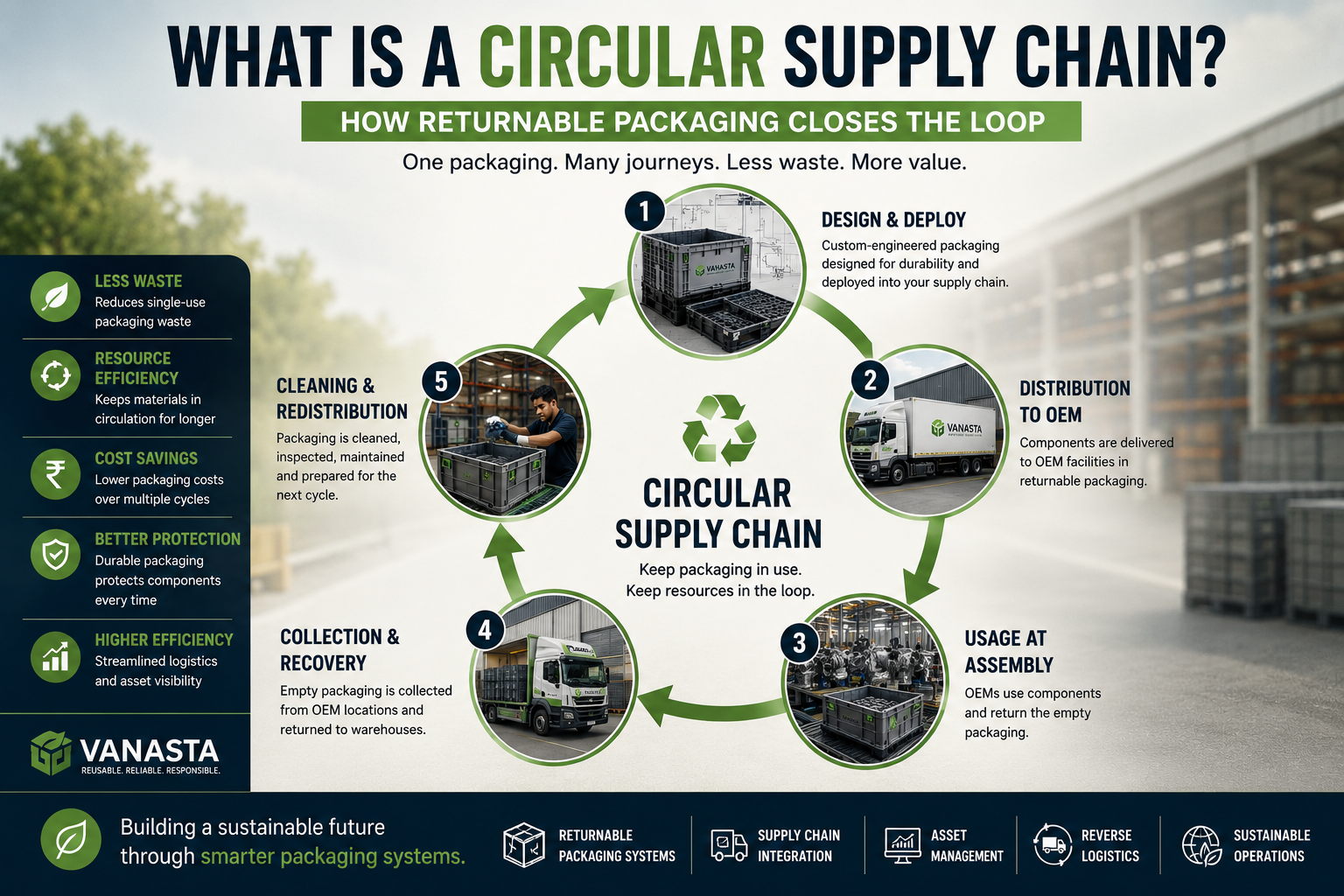
VANASTA’s Five-Stage Closed Loop
VANASTA documents a five-stage packaging lifecycle.
Stage 1: Design & Deploy
The process begins with packaging design.
Packaging is developed around:
- Component dimensions
- Product requirements
- Operational processes
- Transportation requirements
The packaging is then deployed into the supply chain.
Stage 2: Distribution to OEM
Suppliers use the returnable packaging to send components to OEM facilities.
Stage 3: Usage at Assembly
The OEM removes the components and uses them during its assembly operations.
Stage 4: Collection & Recovery
The empty packaging is collected from OEM facilities and returned to warehouses.
Stage 5: Cleaning & Redistribution
The packaging is cleaned, inspected and maintained before being prepared for the next cycle.
The process then starts again.
Why Reverse Logistics Is Critical
A returnable packaging system cannot work without recovery.
The packaging needs to come back.
This makes reverse logistics one of the most important components of circular packaging.
VANASTA provides dedicated collection and return logistics along with forward and reverse logistics capabilities.
Forward logistics moves packaging and components toward the destination.
Reverse logistics brings packaging assets back into circulation.
Together, they create the closed loop.
The Importance of Packaging Maintenance
Reusable packaging experiences repeated handling.
Over time, containers can experience:
- Wear
- Damage
- Contamination
- Component failure
- Structural deterioration
Regular inspection and maintenance help keep assets suitable for repeated cycles.
VANASTA includes warehouse maintenance and quality control specifically to keep reusable assets performing through repeated cycles.
Circularity Is Also an Operational Strategy
Circular packaging should not be viewed only as an environmental initiative.
A well-designed circular system can also improve:
- Packaging availability
- Inventory visibility
- Logistics coordination
- Asset utilization
- Product protection
- Packaging lifecycle management
This is why VANASTA positions sustainability alongside business efficiency rather than treating them as separate objectives.
Leave A Comment